Saving money in Mauritius
Updated: Jun 16, 2025
The 14th-month salary and the WRA (Wage Relativity Adjustment) have been a blessing for most Mauritians. Whether it was to help you get yourself a nice gift, to gift others, or to spend it on a nice dinner, it was a great opportunity to invest in things that we wouldn't be offering ourselves in the first place. However, the release of the State of the Economy by the new government triggered concerns regarding the reliability of price fluctuations and future depreciation of the rupee. In this chaotic and unstable climate, it's important to remain focused on your financial goals. One of the best ways to achieve those is to understand how to save money.

Define your spending habits
Whether you currently have a loan, bills, or a monthly Netflix payment, you need a good understanding of where does your money go. In order to do so, ask yourself these questions:
Do I need this or do I want this?
How is this helping me on a daily basis?
How much time can I go without it?
Can I replace this by something else?
In my situation, grocery shopping is mandatory but sometimes I like to eat out. However it's something that I could have avoided; it's unhealthy food that isn't really value for money compared to grocery shopping. It's my big default and I need to control that. Doing this reasoning helped me to be more conscious whenever I want to order some food.
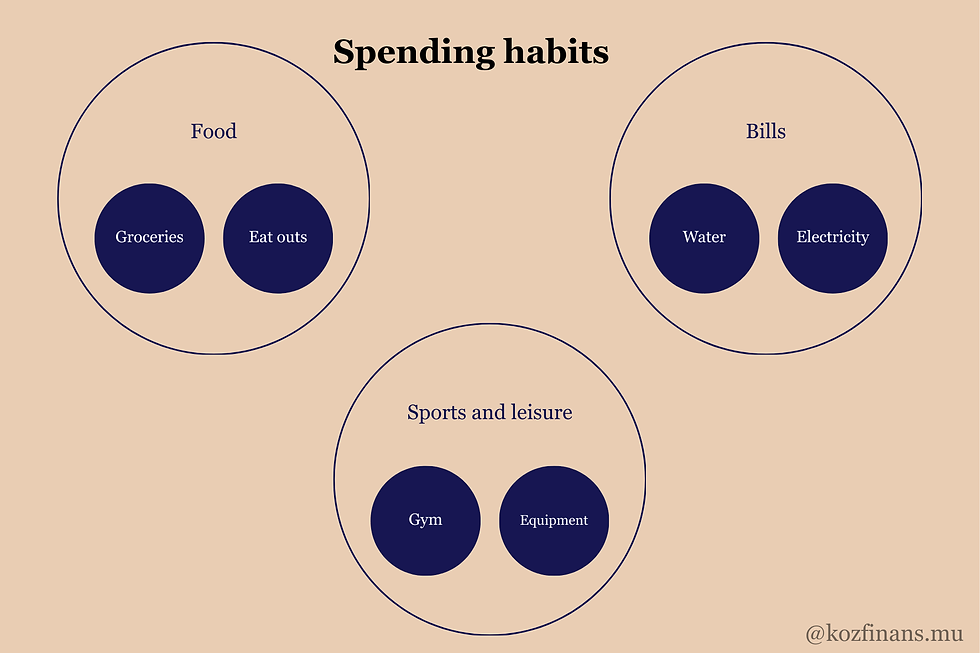
Once you did that, write it on some piece of paper. In my example I divided food under two categories; groceries and eat outs. Here's and example:
Create budgets
Thanks to the effort you provided, you the next step is to create budgets for each category. Here are a few tips:
Count your monthly groceries for three months and do the average.
For example; if you spent 5,000 Rs on January, 6,000 Rs on February and 3,000 Rs, your average month will be around 4,600 Rs. Try and set that amount as the maximum spending for the year on a monthly basis.
Repeat the process for every spending habit; do you go out a lot? do you go to the gym? what are your standing orders for?
As a 23 year old studying and working part-time I spend around 40% of my income in groceries and another 20% in eat outs. It's important to take into account that I live with my parents so I contribute to the family groceries as well.
To help me clearly identify those spending areas I use the Debit and Credit app which is a free app that quite literally changed my life. I will be doing a video on how to use it. For our fellow android users, this app cannot be used.
What's left?

You now have filtered what's necessary to what's unnecessary, created budgets to your daily/monthly spends; what's left then?
Whatever you have left is what you will be working with. Based on my experience, if you have more than 20% of your income left, you can still dispatch some of that money into other areas. It's important to save money but it's better to invest that money into things that keep you happy and motivated to move along.
Overview

Overall, it really depends on your goals and your situation. As a student living with their parents, it's way easier than to live alone with rent and bills to pay. On the other hand, if you have that in mind and take action in this favorable situation, you can alleviate your parent's stress later down the line, when you have saved enough to cover some of your own expenses and take over your life by yourself.
Saving is a great way to build your capital but all your efforts are slowly getting eaten away by the mighty Goliath: inflation. In order to beat that demon, investing is the sling used to kill Goliath; and thanks to your months of saving, you will be able to build yourself something called an emergency fund, the first step into investing.


Comments